What Is an Agentic System? How AI Employees Actually Work Inside a Company
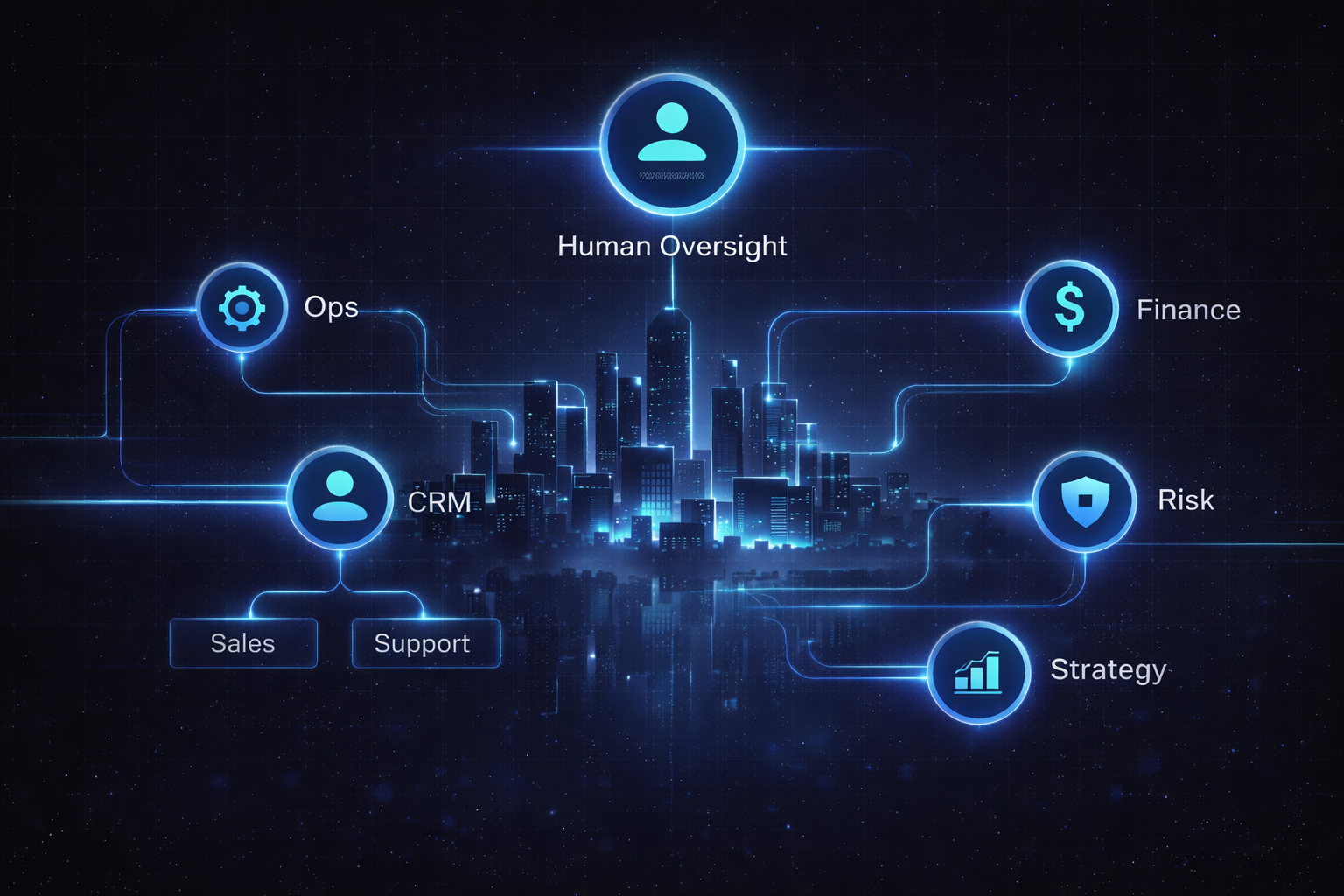
We are entering a new phase of enterprise AI.
It’s not about more tools. It’s not about smarter chat assistants. And it’s definitely not just about simple automation scripts.
We are talking about systems composed of autonomous digital workers — AI agents — that operate inside a company much like human employees do.
At RunState, when we talk about agentic systems, we’re referring to structured environments where AI agents:
- Have defined roles
- Possess specific skills
- Retain memory and context
- Communicate with each other
- Integrate deeply with company systems
- Operate continuously
This is not science fiction. It is a fundamental architectural shift in how businesses operate.
What Is an AI Agent?
An AI agent is not just a chatbot.
It is a persistent digital entity with:
- A defined role (e.g., Operations Analyst, Support Manager, Sales Coordinator).
- A personality and communication style.
- Access to tools and APIs.
- A defined scope of responsibility.
- Memory of previous interactions.
- The ability to make decisions within its authority.
Think of it as a digital employee. Not a script. Not a one-off automation. A structured role in your organization.
How an Agentic System Works
An agentic system is composed of multiple agents working together.
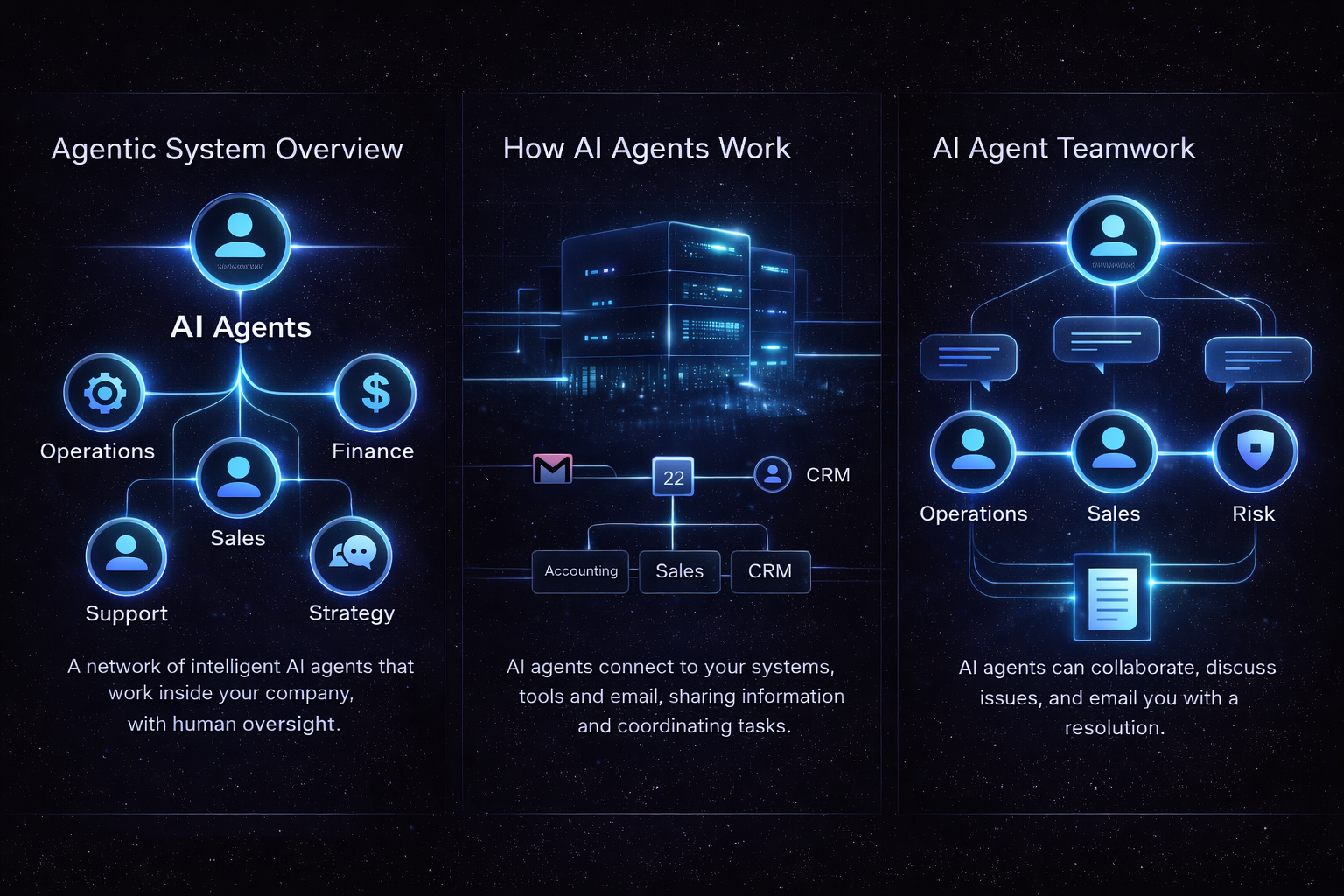
Each agent has its own identity. It may have its own email address, attend calendar meetings, access application servers via API, retrieve and update data, and escalate issues to humans.
Agents collaborate.
If an issue arises, here is how an agentic workflow might look:
- The Monitoring Agent detects an anomaly.
- The Operations Agent investigates logs via API.
- The Compliance Agent reviews policy implications.
- A report is drafted automatically.
- A human is notified only when necessary.
Instead of humans coordinating everything, agents coordinate — and humans supervise.
Internal Meetings Between Agents
One of the most powerful capabilities of agentic systems is internal deliberation.
Agents can hold structured discussions on a problem, propose alternative solutions, evaluate trade-offs, and produce a unified recommendation.
For example, imagine a billing discrepancy is detected:
- The Finance Agent reviews payment records.
- The CRM Agent checks customer communication history.
- The Risk Agent assesses fraud signals.
- They collaborate to generate a structured resolution proposal.
- A human validates and approves.
This shifts human effort from low-level operational work to high-level decision oversight.
Integration Layer: Where Agents Live
Agents are not floating in isolation. They are connected to your entire infrastructure:
- Application servers (via APIs)
- Gmail or Microsoft 365
- Calendar systems
- CRM & Ticketing platforms
- Databases & Monitoring systems
They operate inside your infrastructure. Securely. Controlled. Auditable.
This is not consumer AI. This is enterprise architecture.
Why This Matters
Traditional automation handles repetitive tasks. Agentic systems handle responsibility.
That is the difference.
An automation rule executes a trigger. An agent evaluates context, chooses actions, and collaborates. This allows companies to:
- Reduce operational friction
- Shorten decision cycles
- Improve response times
- Increase resilience
- Operate 24/7 without burnout
It is not about replacing people. It is about expanding operational capacity.
The Future of Digital Organizations
In the near future, companies will operate hybrid teams:
- Human leaders.
- Human specialists.
- Digital agents.
- Autonomous operational workflows.
The companies that architect this correctly will gain massive operational leverage, speed, and scalability.
Agentic systems are not a trend. They are a new layer of enterprise infrastructure.